

The 2D DataMatrix Barcode Requirements for Healthcare
DataMatrix 2D barcodes are the global standard for healthcare item identification, driven by stringent regulatory frameworks such as the FDA Unique Device Identification (UDI) system in the United States and the EU Falsified Medicines Directive (EU FMD). Unlike traditional linear barcodes, 2D DataMatrix codes pack high-density data into a compact footprint, enabling full traceability down to the individual serial number, lot, and expiration date.
This step-by-step guide walks healthcare manufacturers, re-packagers, and hospital distributors through technical requirements, data structuring, optical quality standards, and integration best practices.
Technical & Data Standards Breakdown
Healthcare 2D DataMatrix barcodes rely on GS1 DataMatrix or HIBC (Health Industry Bar Code) syntax. GS1 is the most widely adopted framework globally.Key Data Elements Encoded
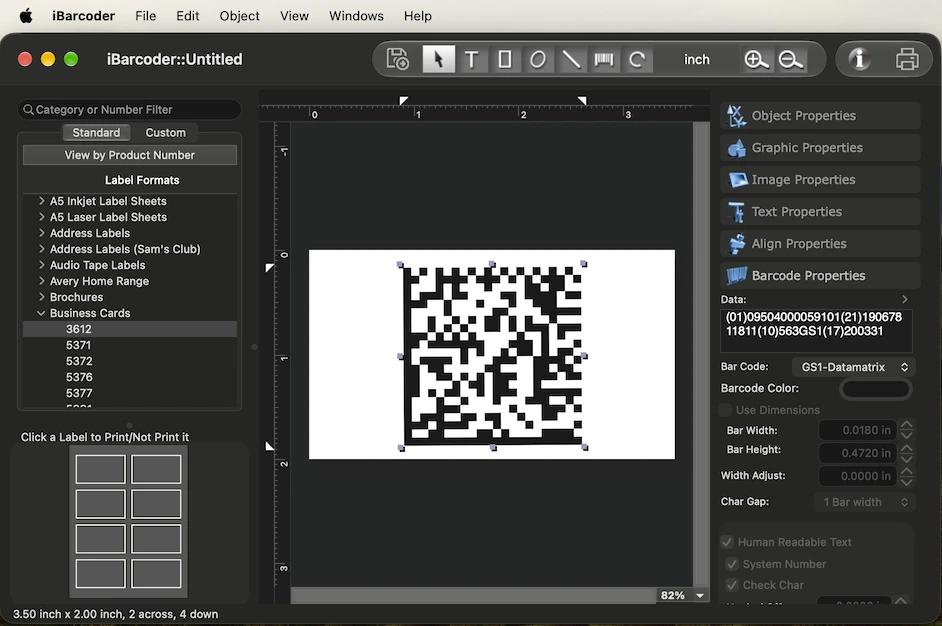
A compliant healthcare DataMatrix code generally includes four key variable fields using GS1 Application Identifiers (AIs):- • Global Trade Item Number (GTIN) / Device Identifier (DI): (AI 01) — 14-digit numeric code identifying the product.
- • Expiration Date: (AI 17) — Expressed in YYMMDD format.
- • Batch / Lot Number: (AI 10) — Alphanumeric string up to 20 characters.
- • Serial Number: (AI 21) — Unique alphanumeric identifier up to 20 characters.
Step-by-Step Implementation Guide
Step 1: Establish Your Data Syntax & Primary Identifiers
Determine whether your regulatory domain or trading partners require GS1 DataMatrix or HIBC DataMatrix.- 1. Obtain your GS1 Company Prefix or HIBC Labeler Identification Code (LIC).
- 2. Assign individual GTINs or HIBC Part Numbers to every Stock Keeping Unit (SKU), packaging level (unit-of-use, inner pack, case), and configuration.
- 3. Establish data mapping between your Enterprise Resource Planning (ERP) or Manufacturing Execution System (MES) and your packaging line serialization software.
Step 2: Determine Physical Dimensions & Quiet Zone
Ensure the physical mark fits the packaging substrate without compromise to scanner readability.- • Module Size (X-Dimension): The width of a single square module within the DataMatrix grid. For healthcare, the recommended minimum X-dimension ranges from 0.254 mm (10 mil) to 0.381 mm (15 mil) for printed packaging.
- • Quiet Zone: A border of clear space surrounding all four sides of the 2D code. The GS1 standard mandates a quiet zone width of at least 1 module (1X) on each side (though 2X or more is strongly recommended for high-speed automated sorting).
- • Direct Part Marking (DPM): For medical instruments or surgical tools etched directly via laser or dot peen, smaller module sizes (down to 5 mil) may be used, provided dedicated direct-part scanners are deployed.
Step 3: Implement Packaging Line Marking Hardware & Substrates
Select marking technology based on substrate material, line speed, and production environment.| Technology | Ideal Substrate / Application | Key Considerations |
| Thermal Inkjet (TIJ) | Cartons, blister foils, paper labels | High contrast (600 DPI), fast-drying solvent or water inks |
| Laser Marking (CO₂ / Fiber / UV) | Direct carton ablation, plastic, metal | Permanent, zero ink consumables; requires extraction |
| Thermal Transfer (TTO / TTP) | Flexible films, synthetic pouch labels | High contrast; requires proper ribbon-to-substrate matching |
Step 4: Verify Print Quality to ISO/IEC 15415 & 29158 Standards
Regulatory compliance requires inline or offline verification to guarantee grade compliance before product release.- 1. Standards Compliance: Evaluate codes using ISO/IEC 15415 (for printed labels) or ISO/IEC 29158 (AIM DPM) (for direct part marks).
- 2. Target Grade: Healthcare regulators typically require a minimum overall barcode grade of 1.5 (C), with 2.5 (B) or higher considered industry best practice at the point of manufacture.
- 3. Core Parameters Tested:
-
◦ Symbol Contrast (SC): Difference between light and dark modules.
◦ Modulation (MOD): Local contrast uniformity across the matrix.
◦ Axial Non-Uniformity (ANU): Aspect ratio distortion (squareness).
◦ Grid Non-Uniformity (GNU): Deviation of cell placement from regular grid.
◦ Unused Error Correction (UEC): Percentage of ECC200 error correction capacity remaining.
Step 5: Validate Scanning & ERP System Integration
Before full commercial scale-up, perform end-to-end integration testing:- • Validate that downstream scanners (warehouse management systems, bedside administration devices, pharmacy automation systems) accurately decode the FNC1 character and parse the GS1 Application Identifiers into correct ERP database fields.
- • Test code readability under realistic clinical conditions (low ambient light, curved vial surfaces, crumpled foil, and through clear plastic overwraps).
Compliance Checklist
| Requirement | Specification / Action |
| Data Format | GS1 DataMatrix (ECC200) with proper Application Identifiers |
| Error Correction | ECC200 standard mandatory (Reed-Solomon algorithm) |
| Print Quality Grade | Minimum ISO/IEC 15415 Grade 1.5 (C); Target 2.5 (B) |
| Human-Readable Text | Equivalent data printed adjacent to symbol (GTIN, Lot, Exp, Serial) |
| Inline Verification | Automated vision system / verifier configured on packaging line |