

The What is the difference between 1D and 2D barcode makers?
Whether you are printing UPC labels for retail, generating ISBN barcodes for self-publishing, managing warehouse inventory, or linking customers to digital media with QR codes, choosing the right barcode software is critical.
The primary difference between a 1D (one-dimensional) and a 2D (two-dimensional) barcode generator lies in data capacity, structural layout, scanner compatibility, and supported symbologies.
At a Glance: 1D vs. 2D Barcode Comparison
| Feature | 1D Barcode Maker (Linear) | 2D Barcode Maker (Matrix) |
| Visual Structure | Vertical parallel lines and spaces | Two-dimensional patterns, squares, or dots |
| Data Encoding Axis | Horizontally only (1 Dimension) | Horizontally and Vertically (2 Dimensions) |
| Data Capacity | Low (~20 to 80 alphanumeric characters) | High (Up to 7,000+ numeric or 4,200+ alphanumeric) |
| Data Types | Numbers, basic alphanumeric text | URLs, contact cards (vCards), binary, images, plain text |
| Common Formats | UPC-A, EAN-13, Code 128, Code 39, GS1-128 | QR Code, Data Matrix, PDF417, Aztec |
| Error Correction | None or minimal (requires undamaged label) | Built-in redundancy (readable even if partially damaged) |
| Scanning Hardware | Standard 1D laser scanners or 2D imagers | 2D camera-based imagers, smartphones, tablets |
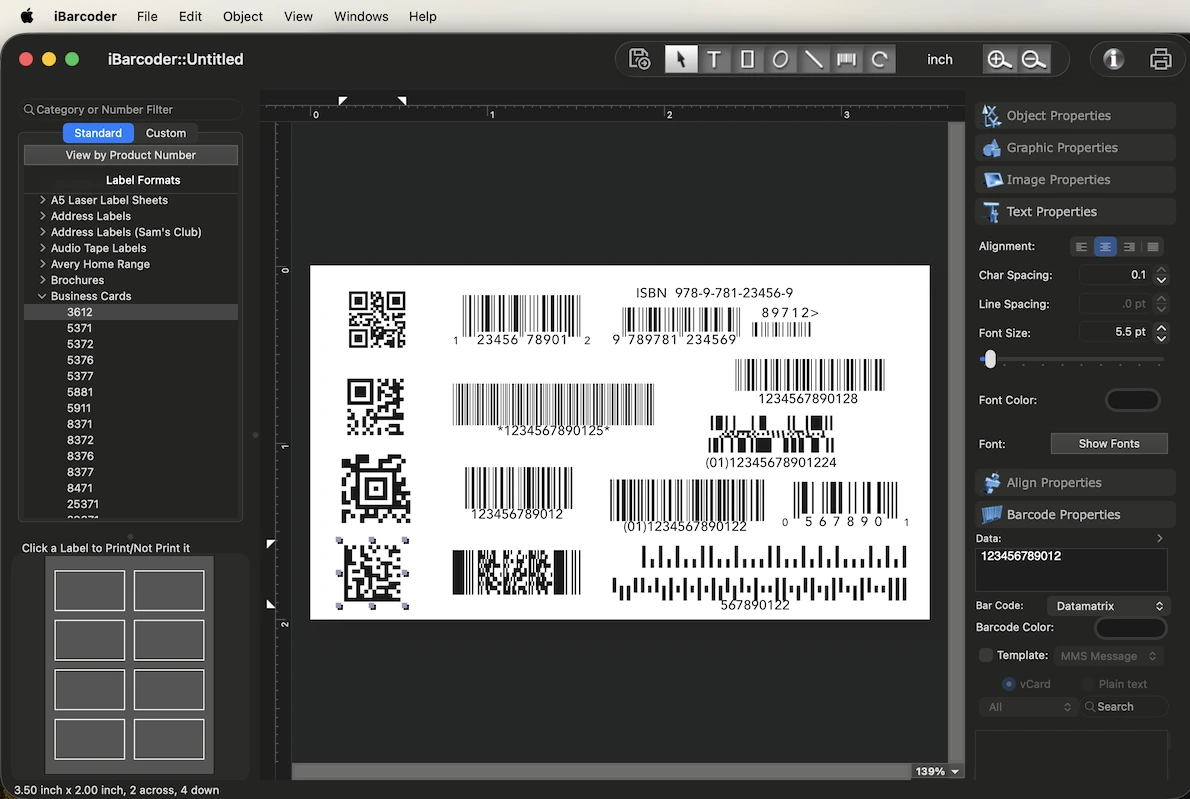
What is a 1D Barcode Maker?
A 1D barcode generator creates traditional linear barcodes composed of parallel black lines and white spaces of varying widths. The data is read horizontally from left to right across a single axis.Because 1D barcodes hold a limited amount of data, they typically serve as a lookup key to point to a record in a database rather than storing complete information within the barcode itself.
Key Characteristics of 1D Barcodes:
- • Database Dependent: The barcode usually contains an identification number (e.g., a product SKU or ISBN number). When scanned, the system pulls item details, prices, or inventory levels from a central server.
- • Broad Scanner Compatibility: Can be scanned by inexpensive 1D laser scanners found in standard point-of-sale (POS) systems.
- • Physical Space Requirement: As you encode more characters into a 1D barcode, the symbol must grow wider, which can lead to layout constraints on small packaging.
Popular 1D Formats:
- • UPC-A & EAN-13: Standard retail barcodes used worldwide for product checkout.
- • Code 128 & Code 39: Versatile industrial barcodes used for logistics, asset tracking, and shipping labels.
- • GS1-128: Used across supply chains to bundle batch numbers, expiration dates, and serial numbers.
What is a 2D Barcode Maker?
A 2D barcode generator creates matrix barcodes that store information both horizontally and vertically across two dimensions. Instead of simple lines, 2D barcodes use geometric shapes, squares, and patterns.Because 2D barcodes store significantly more data in a much smaller physical footprint, they can hold complete files, web links, or detailed batch data directly inside the code without needing an immediate database connection.
Key Characteristics of 2D Barcodes:
- • High Data Density: Can store thousands of characters in a fraction of an inch.
- • Built-In Error Correction: Features algorithms (like Reed-Solomon) that allow the code to be successfully scanned even if up to 30% of the surface is smudged, torn, or covered.
- • Omnidirectional Scanning: Can be read from any angle or orientation using camera-based 2D imagers or smartphone cameras.
- • Rich Data Integration: Capable of storing web URLs, contact info, Wi-Fi credentials, encrypted data, and complex inventory records..
Popular 2D Formats:
- • QR Code: Widely used in marketing, mobile payments, ticketing, and restaurant menus.
- • Data Matrix: Compact 2D code frequently used for marking small industrial parts, electronics, and pharmaceutical packaging.
- • PDF417: Stacks multiple linear codes to store large datasets; heavily used on driver's licenses, boarding passes, and logistics manifests.
Key Technical Differences Explained
1. Data Capacity & Physical Footprint
To add more characters to a 1D barcode, you must add more vertical bars, making the barcode wider. If you try to shrink it too much, standard scanners lose accuracy. In contrast, 2D barcodes store data along both axes, allowing you to fit entire sentences or web addresses into a small, square space without sacrificing scannability.2. Physical Damage Tolerance
If a 1D barcode suffers a tear across its bars, a laser scanner may fail to read it entirely. 2D barcodes include built-in error correction, which means a dirty or scratched 2D label on a shipping box or warehouse shelf can still be scanned effortlessly.3. Hardware Requirements
- • 1D Barcodes: Can be read by virtually any scanner, including older, low-cost linear laser scanners.
- • 2D Barcodes: Require 2D image scanners or camera-based devices (like smartphone cameras). Linear laser scanners cannot read 2D matrix codes.
How to Choose the Right Software Maker for Your Needs
When selecting desktop barcode software or a dedicated label generator, consider the following requirements:- 1. 1D Retail & Publishing (Go with 1D): If you are selling physical goods in retail stores or publishing books, standard 1D formats like UPC-A, EAN-13, or ISBN are required for point-of-sale checkout systems.
- 2. Marketing & Mobile Engagement (Go with 2D): If you want customers to visit a landing page, save a contact card, or view an interactive document, choose software capable of generating custom QR Codes.
- 3. Logistics & Inventory Management (Use Both): Modern shipping and warehouse operations often combine GS1-128 (1D) for shipping containers with Data Matrix or QR Codes (2D) for precise item tracking and automated batch scanning.